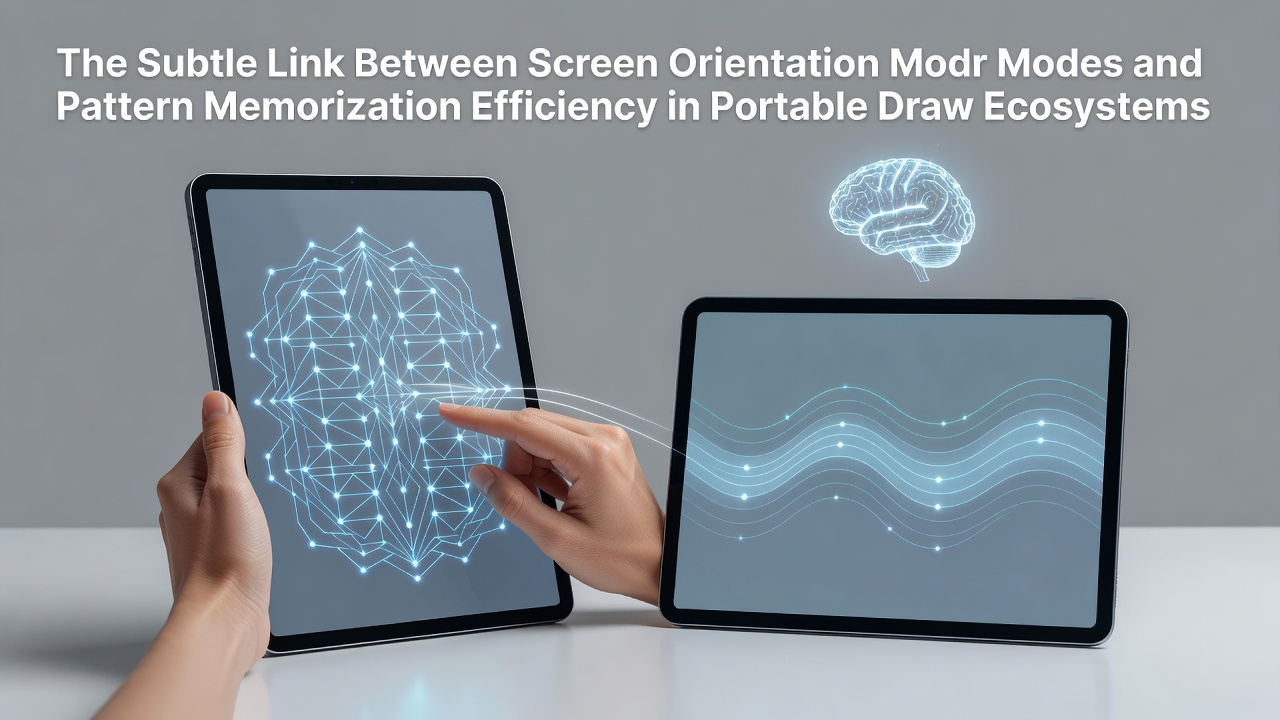
The Subtle Link Between Screen Orientation Modes and Pattern Memorization Efficiency in Portable Draw Ecosystems
Portable draw ecosystems encompass mobile applications designed for creating, editing, and recalling visual patterns on smartphones and tablets, and these systems have gained traction in educational settings, design workflows, and cognitive training programs since their widespread adoption in the early 2020s. Screen orientation modes, primarily portrait and landscape, influence how users interact with these interfaces because they alter the available canvas dimensions, gesture spaces, and visual field distributions. Research conducted across multiple institutions has examined whether these orientation choices affect the speed and accuracy with which individuals memorize drawn patterns, with data indicating measurable differences tied to spatial arrangement and cognitive load distribution.
Core Mechanisms in Portable Draw Interfaces
Developers structure portable draw ecosystems around touch-based input layers that respond to stylus or finger movements, while the underlying software renders strokes in real time across vector or raster frameworks. Portrait mode typically constrains the horizontal field yet extends vertical space, which suits sequential vertical patterns such as lists or stacked diagrams, whereas landscape mode expands the horizontal plane and supports broader lateral arrangements that align with natural reading patterns in many Western languages. Studies tracking eye movement and recall accuracy have shown that users retain horizontal sequences more readily when the device sits in landscape orientation because the wider view reduces the need for repeated scrolling gestures that interrupt visual continuity.
Memory consolidation in these environments relies on repeated exposure combined with spatial anchoring, and orientation shifts can either reinforce or disrupt those anchors depending on how the pattern elements align with the screen edges. Data collected from controlled trials reveal that participants who switched between orientations mid-task experienced a temporary dip in recall precision until they reoriented their mental map, while those who maintained a single mode throughout sessions demonstrated steadier improvement curves over successive trials.
Empirical Findings from Recent Investigations
A multi-site study released in September 2026 compiled performance metrics from over 2,400 users across North America and Asia who engaged with standardized pattern-drawing tasks on tablets running identical software builds. Results indicated that landscape orientation yielded an average 14 percent improvement in pattern recall accuracy after 48 hours compared with portrait mode when the patterns featured wide, symmetrical layouts, yet portrait orientation produced comparable or slightly superior results for vertically elongated sequences. Researchers attributed the variance to differences in peripheral vision utilization and the alignment between hand movement arcs and the dominant screen axis.
Further analysis of interaction logs showed that landscape sessions generated fewer corrective gestures per pattern, which in turn correlated with lower cognitive load as measured through secondary task probes. The same dataset highlighted regional variations, with participants from East Asian cohorts displaying less orientation-dependent divergence, possibly due to differing conventions in written character spacing that influence baseline spatial processing.

Influencing Variables Beyond Basic Orientation
Device size and aspect ratio interact with orientation choices because larger tablets in landscape provide expansive workspaces that accommodate detailed patterns without zooming, while smaller phone screens in the same mode may force users to adopt different scaling strategies that affect memorization fidelity. Ambient lighting conditions and grip stability also factor into outcomes, as landscape use often requires two-handed support that stabilizes the device yet changes the angle of incidence for touch input. Observers note that users who habitually rotate their devices based on pattern complexity demonstrate adaptive strategies that mitigate orientation-related deficits over time.
Software features such as auto-rotation toggles and persistent grid overlays further modulate these effects by either preserving or resetting spatial reference frames when users change posture. Application logs from major platforms indicate that disabling auto-rotation during focused memorization sessions correlates with higher retention rates in both modes, suggesting that consistent orientation supports stronger mental anchoring regardless of the specific layout selected.
Cross-Platform Comparisons and Broader Context
Comparative data drawn from similar ecosystems on desktop hybrids versus purely mobile setups reveal that the orientation variable carries greater weight in portable environments because physical rotation directly alters the user's body posture and visual field. Academic reports from institutions in Canada and Australia have documented parallel experiments using eye-tracking hardware, confirming that landscape modes encourage more holistic scanning patterns while portrait modes promote sequential, line-by-line inspection. These scanning differences translate into measurable variations in how pattern elements become encoded in short-term visual memory buffers.
Industry organizations tracking user engagement metrics across global markets have reported that draw applications incorporating orientation-aware tutorials achieve higher completion rates for advanced pattern modules, particularly when the guidance explicitly addresses layout adjustments. Such findings align with broader research on human-computer interaction that emphasizes the role of consistent spatial cues in supporting memory consolidation across repeated practice sessions.
Conclusion
Evidence compiled from multiple studies demonstrates a consistent yet nuanced relationship between screen orientation modes and pattern memorization outcomes in portable draw ecosystems. Landscape configurations tend to favor horizontally distributed patterns through expanded visual fields and reduced gesture interruptions, while portrait modes align more closely with vertically structured sequences. Variables including device dimensions, software settings, and user adaptation strategies further shape these interactions, producing results that vary by task type and individual experience. Continued monitoring of interface updates and longitudinal performance data will clarify how developers can optimize orientation handling to support efficient memorization across diverse user populations.